The Frost Laboratory: Integrative and Applied Chemical Ecology

Integrative and Applied Chemical Ecology
Every organism interacts with its environment through chemistry. Over evolutionary time, these interactions have unfolded through chemical signals, defenses, and metabolic exchanges that structure ecological systems. Ecology describes interactions among organisms and their environment; chemical ecology focuses on how natural chemicals mediate those interactions across biological scales.
Organisms use chemistry to communicate, to defend themselves, to sense risk, and to modify their physiological state. These chemically mediated processes shape species interactions, influence evolutionary trajectories, and scale to structure communities and ecosystems.
Many of these compounds, particularly plant produced metabolites involved in defense, signaling, and stress resilience, also have relevance to human health, agriculture, and ecosystem management.
Our lab studies how these chemicals are regulated, how they function in ecological interactions, and how their roles shift under environmental change. We are also interested in how anthropogenic chemicals and global change drivers intersect with natural chemical signaling to alter ecological processes.
What does our lab do?
Plants live under continuous stress. They compete for limited resources, experience attack by herbivores and pathogens, interact with mutualists, and face increasingly variable abiotic conditions such as drought, temperature extremes, elevated CO2, and nutrient limitation. Unlike animals, plants respond to these challenges in place.
Plants achieve resilience largely through chemistry.
Our lab investigates how plant chemistry mediates interactions with insects, microbes, and the abiotic environment, and how these interactions shift across environmental contexts. We focus on the regulatory mechanisms that generate chemical variation by linking gene expression, hormonal signaling, metabolism, and physiological state to ecological outcomes.
A central theme of our work is phenotypic plasticity, the capacity of organisms to modify traits in response to environmental variation. In plants, plasticity in chemical traits is critical for responding to herbivory, pathogen pressure, and fluctuating resource availability, particularly under global change.
One example is that plants can perceive volatile chemical cues in their environment, allowing them to sense risk and prime defensive responses before damage occurs. This chemically mediated perception alters plant insect interactions and defense strategies, with implications for ecosystem dynamics and for biologically informed pest management.
Importantly, these responses extend beyond the individual plant. Chemically driven changes in plant physiology influence nutrient cycling, soil microbial communities, and other ecosystem level processes, often creating legacy effects that persist beyond the lifespan of individual plants.
In short, chemically mediated interactions connect molecular regulation to population, community, and ecosystem dynamics.
Phenotypic Plasticity and Ecological Resilience
Phenotypic plasticity, the ability of organisms to modify traits in response to environmental conditions, is central to ecological resilience in a changing world. In plants, plasticity is especially evident in chemical traits regulated through coordinated interactions among gene expression, protein synthesis, phytohormone signaling, and metabolic pathways.
As a plant and insect biologist, I investigate how this regulatory complexity generates functional chemical trait variation. As an ecologist, I study how chemically driven trait variation alters interactions with insects, microbes, and the environment, including both direct and indirect effects across trophic levels.
By linking plant chemistry to ecological interactions, we aim to understand how plasticity influences resistance, tolerance, and recovery from both biotic and abiotic stress, and how these processes shape resilience, stability, and ecological change across biological scales. These same mechanistic insights also inform Integrated Pest Management and sustainable pest management strategies that seek to align agricultural practices with ecological processes.
Applications of our research
Beyond fundamental questions in chemical ecology, we examine how plant specialized metabolism can be leveraged to address environmental and agricultural challenges. Many secondary, or specialized, metabolites that plants use for defense and signaling have applications in medicine, agriculture, and biotechnology.
Our work integrates mechanistic understanding of plant insect interactions with broader questions in global change biology. By resolving how chemical defenses are regulated under drought, temperature stress, altered nutrient regimes, and other climate drivers, we contribute to frameworks that support ecologically grounded Integrated Pest Management and climate aware sustainable pest management.
My interest in plant defense chemistry has roots in ethnobotany and in understanding how humans have long utilized plant chemical diversity. Polyphenolics, terpenes, and other defense related compounds remain central to crop protection, sustainable agriculture, and human health.
By studying plant chemical ecology in realistic environmental contexts, our research advances both fundamental understanding of the selective forces shaping natural systems and applied approaches that support resilience in managed and natural ecosystems under global change.
Disclaimer
Much of our work is funded by external sources. Any opinions, findings, conclusions, or recommendations expressed in this material are those of the author(s) and do not necessarily reflect the views of the National Science Foundation or other funding agencies or universities.
Lab News |
 Sophie Awarded an NSF Graduate Research Fellowship! Yipee!!!
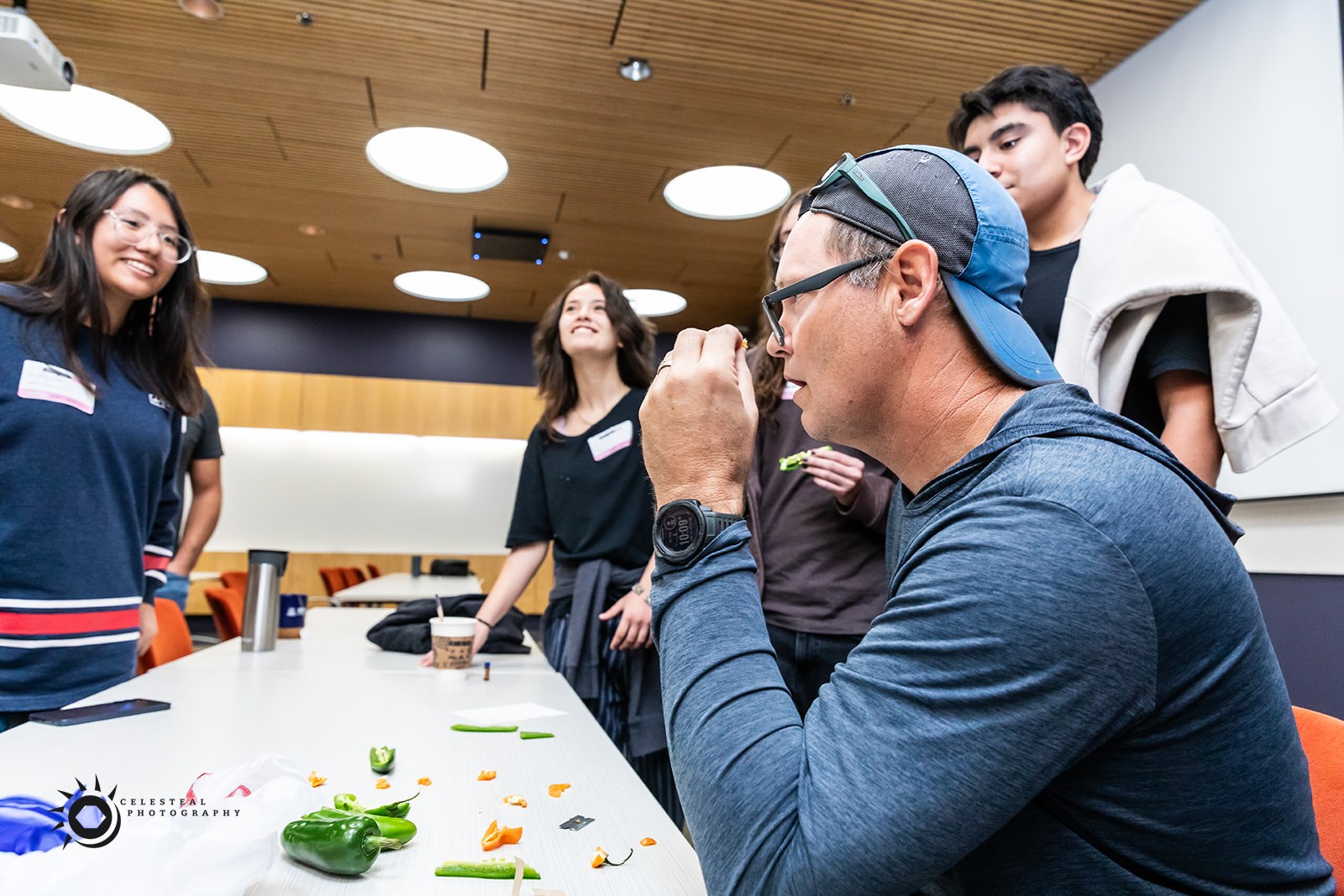 Chris gives a invited presentation to Creative Mornings Tucson
, around the theme of "Growth". Plant Odors, Personal and Mentorship growth, and capsaicin were on the menu!
Chris gives a invited presentation to Creative Mornings Tucson
, around the theme of "Growth". Plant Odors, Personal and Mentorship growth, and capsaicin were on the menu!
WATCH THE VIDEO HERE!  Lab awarded $100,000 UofA Arizona Institute of Resilience (AIR) Resilient Arizona grant! Dr. Emily Waggoner is a co-PI on this project and her postdoc will be spearheading the AIR Resilient Arizona work - determining the ecosystem-level fate of OPEs in the Santa Cruz River.
 New Paper on auxin regulation, a collaboration building from our lab's phytohormone quantification protocol!
 Daniel awarded research funds from the Ecosystem Genomics GIDP!
Sophie Awarded An ASPB Summer Fellowship in our Lab!
Daniel awarded research funds from the Ecosystem Genomics GIDP!
Sophie Awarded An ASPB Summer Fellowship in our Lab!


|